Showing posts with label Financial Crises. Show all posts

Thursday, July 1, 2010

Summer Reading

Whenever I find something on the internet that interests me--about which I, correctly or not, presume myself to have something novel to say, or that I, (again) correctly or not, presume one or some or all of you might be interested in--I open up a tab and leave it there for later. Later, because I conduct most of my serious weekly internet scowering in those narrow bands of time between consciousness, work, and the weekend. And in those bands of waking, unoccupied or inebriated freedom that flicker by my each week, I am usually in a hurry (before work) or exhausted (after). So the grand masterstroke of biting analysis I had first envisioned only rarely becomes more than a stale tab of news past eventually deleted.

I have a few tabs open now. These tabs have been held open for too long now. My browser is getting sore. So, instead of deleting them, I thought I'd just post all the links here in a barrage of lazy, incoherence on my part. These links are not particularly thematically consistent (most of the news referenced therein is bad, so there's that). I just found them interesting, thought they were worth sharing, and figured at least a few of them might have slipped under a radar or two.

On Fossil Fuels:
I'll only add here that as maddening as the consistently lax regulatory oversight featured in all four of these stories may be, I couldn't help but think back to the Lisa Margonelli piece I linked to in a post back in May. Her basic premise was that if we aren't mining it from our own backyards, the oil and gas we consume is coming from someone else's. The disaster in the gulf is only exactly what the Niger Delta has been going through ever year since the 1960s. And on the issue of gas, this excerpt from the Propublica fracking piece speaks for itself:
Last month President Dmitri Medvedev of Russia said he would curtail natural gas production by the state company Gazprom until the study is completed. In part that’s because Medvedev isn’t sure there will be a viable market for Russian gas if the U.S. develops its domestic reserves, and because he believes that the regulations that could result from the EPA study could determine whether the U.S. drills its own gas, or imports it from overseas.
So, on our fossil fuel problem: It's demand, stupid!

On economic development:
I wanted to write something about the first link, the recorded lecture of Ha-Joon Chang, when it first came out months ago. I eventually gave up on the idea believing, probably accurately, that I wouldn't have much to say about it and that nobody would bother to listen to the whole thing anyway. But whether or not you bother to check out either of these, Chang and Rodrik hit on a pretty interesting (and obviously relevant) point. Development, they both believe, is not achieved by addressing adhoc and after-the-fact the symptoms of its absence (corruption, lack of access to health-care, poor education, etc). The definition of development they ascribe to is, instead, a process of macroeconomic structural change, in which the society as a whole moves from low productivity work to higher productivity work. And if those are the set of assumptions you carry around with you, the potential role of government you envision within that process is much, much broader.

On Financial Crises and How to Fix Them:
Back in March, I linked to Paul Krugman's article and posted the following:
There are times when even a highly imperfect reform is much better than nothing; this is very much the case for health care. But financial reform is different. An imperfect health care bill can be revised in the light of experience, and if Democrats pass the current plan there will be steady pressure to make it better. A weak financial reform, by contrast, wouldn’t be tested until the next big crisis. All it would do is create a false sense of security and a fig leaf for politicians opposed to any serious action — then fail in the clinch.
As to how things stand now, I've yet to read a comprehensive run-down of the entire bill (or at least, what's likely to be in the final-est of final versions). So, though I'd like to agree with Russ Feingold as a matter of mancrush, and though I'd like to seek comfort in my original cynicism, I honestly can't judge here. I just don't know very much about the bill itself. I don't know how strong the strong derivatives language is. I don't know how protective the consumer protection will be. I don't know how tough the tougher proprietary trading rules are. Anyone?

So that's that. And, just saying and everything, I would totally welcome similar suggested reading posts from all of you.

Sunday, February 7, 2010

Euro Crisis Update (Lazy Block-quote Edition)

First, Simon Johnson:
Some financial market participants cling to the hope that the stronger eurozone countries, particularly Germany, will soon help out the weaker countries in a generous manner. But this view completely misreads the situation.

The German authorities are happy to have the euro depreciate this far, and probably would not mind if it moves another 10-20 percent. They are convinced that they must – in fact, should – export their way back to acceptable growth levels.

Competitive depreciation is of course a no-no in international policy circles. But if your dissolute neighbors – with whom you happen to share a credit union – threaten to implode their debt rollovers, and markets react negatively, how can you be held responsible?
[...]
The euro depreciates, the dollar strengthens, and our path to recovery starts to run more uphill.

And if these European troubles start to be reflected in difficulties for leading global banks over the next few days or weeks, the negative impact will be much greater.
Then, Yves Smith:
We do have a factor here that could get the reluctant Europeans, meaning the Germans in particular, to act, namely, that Eurobanks are still wobbly and are not doubt exposed directly and indirectly to a European sovereign debt crisis. There is no way to avoid rescue operations of some sort, it’s merely a matter of picking which poison. Do they want to face the ugly bailout of countries they see as profligate, or wait till it morphs into a crisis and have to put their banks on emergency life support? The problem is the latter is politically more palatable, even though ultimately more destructive, since a lot of collateral damage will occur in the wave that hits the banks.
And just for the sake of reiteration, lastly, Paul Krugman:
Spain is an object lesson in the problems of having monetary union without fiscal and labor market integration. First, there was a huge boom in Spain, largely driven by a housing bubble — and financed by capital outflows from Germany. This boom pulled up Spanish wages. Then the bubble burst, leaving Spanish labor overpriced relative to Germany and France, and precipitating a surge in unemployment. It also led to large Spanish budget deficits, mainly because of collapsing revenue but also due to efforts to limit the rise in unemployment.

If Spain had its own currency, this would be a good time to devalue; but it doesn’t.

On the other hand, if Spain were like Florida, its problems wouldn’t be as severe. The budget deficit wouldn’t be as large, because social insurance payments would be coming from Brussels, just as Social Security and Medicare come from Washington. And there would be a safety valve for unemployment, as many workers would migrate to regions with better prospects. (Wages wouldn’t have gone up as much in the first place, because of in-migration).

The point is that this has nothing to do with a spendthrift government; what’s happening to Spain reflects the inherent problems with the euro, which now more than ever looks like a monetary union too far.

Monday, February 16, 2009

Another Thing That is Trying to Kill Our Economy

Now that the financial crisis has finally moved on to bigger and better things, infecting the good ol' economy of us regular folks with higher unemployment, home foreclosures and state government budget cuts, maybe you're thinking that the exclusionarily complex, initial-heavy world of investment banks, derivative trading and hedge funds is just so last September.

Well think again, square! Old is the new new, black is last month's red, and incompetently rated asset backed securities are this weeks Chapter 11 bankruptcies (actually, Chapter 11 is still around too, but its probably unfashionably depressing to talk about because it doesn't have a cool acronym):

Standard & Poor’s has highlighted that many collateralised loan obligations – which pool leveraged loans and sell differently rated investment notes with varying risk profiles – have exposure to the same group of borrowers. The default of just one of these widely held borrowers on their debt could have a negative effect on the credit quality of the portfolios of nearly 90 per cent of European CLOs, the agency said in a report.

In fact, the debt of just 35 different borrowers appears in nearly half of the 184 CLO portfolios that S&P rates. In total, those funds hold at least €90bn in assets. (Source: Financial Times)


This is basically the same story that got bandied around the news a lot last summer when everyone was desperately trying to figure out where the world's economy went. Except the cast has changed ever so slightly--by one letter actually. Last year's revelation that the leading rating agencies categorically failed to properly identify the risk in CDOs (financial packages full of different bonds backed by different loans made to different little people who were trying to buy little houses and little cars and little college tuitions), has been replaced with the shocking bit of news that, by the way, those same rating agencies also failed to identify similar risk in CLOs (financial packages full of different bonds backed by different loans made to different big people who are trying to buy big factories and big regional banks and big CDOs).

If you don't follow what I'm saying, the details aren't particularly important. What I think is important is that:

a) the entire point of constructing these needlessly complicated securities (CDOs and CLOs) was to reduce the risk of investment. Loaning money to one person or one company is kind of risky; maybe there is a 10% chance that that person or company will default and the lender will lose out. Loaning money to a whole bunch of people and then repackaging their loans into little, fancily titled securities was thought to be less risky; the risk that all of these loans would stop performing (the debtor would default) simultaneously is significantly less than 10%. But with lax regulation and lax oversight--i.e. rating agencies failing to recognize that the debt of 35 companies is touching perhaps half of the market--these kinds of debt security markets have only amplified rather than dampened the risk.

b) It's been said many a-time but I'll say it again: the rating agencies that evaluate the relative riskiness of these securities either need to be nationalized or to see the very foundations of that industry's business practices reformed. These are private companies that are paid per rating by the companies for whom they are doing the rating. Obviously their customers want a high rating for their bonds and the rating agencies like to retain the business of their customers. Wouldn't it be nice if the Food and Drug Administration worked that way when it decided on whether or not to approve a new anti-depressant ? Or if EPA had to compete with other agencies to evaluate the sulfur emissions of a coal plant?* It doesn't take a Nobel prize winning economist to identify the problem here. In fact, at this point its probably best if we keep the Nobel prize winning economists in the other room for now.

*For the sake of my argument and mental health I am assuming that this is not how either the FDA or the EPA work.

Friday, February 13, 2009

Night of the Living Red*

Confused by the credit freeze? Stumped by the stock market? Flummoxed by finance? Bewildered by balance sheets?

As if it hasn't been talked up enough already, I would really recommend to anyone who is still unclear about the root cause of the credit freeze to check out the most recent episode of "Planet Money." I couldn't figure out how to link the episode directly, so you'll have to rummage through the archives yourselves if you're interested.

If not, the episode is essentially about bank insolvency: how it's define, how its relevant to the current crisis and what the government can or should do about it. It's that last point that I find the most interesting and which I don't think the episode got sufficiently all up in.

To summarize for those who don't know and don't want to listen to the podcast, a bank is insolvent when its liabilities exceed its assets. Actually, the way it's typically stated is when liabilities plus equity exceed its assets, but essentially the concept is the same. A bank is insolvent when it owes more than it has. A bank's liabilities is money it owes to other people (depositers, bondholders, direct lenders, nowadays the government...), while owner's equity is money that the bank itself has (or, more likely, that it owes is shareholders). In any event, liabilities and equity both constitute money that the bank owes to someone or something--either within or outside the bank. Assets, on the other hand, is all the value that the bank has. If Sol's Bank lends $1000 to Sarah, that loan is obviously a liability for Sarah, but for Sol, that grand plus interest is an asset.

Unfortunately, assets aren't always easy to price. If Sarah loses her job and all of a sudden it seems much less likely that she will be able to pay Sol back, the value of Sol Bank's asset is much diminished. By how much? Ask Sol and he will tell you that in all likelihood, Sarah will find a new job, that she will get the money to pay him back, and that his asset is still worth around $1000. Ask investor Dave, though, and he takes a look at Sarah's credit rating, at her person history, at the fact that she spent her $1000 on baking supplies and knitting material, and Dave will say that that asset is as good as worthless. Maybe he would be willing to take it off Sol Bank's hands for $200 (just in case, by some miracle Sarah does get a job and pay back the loan), but no more.

So here we have an asset of indeterminate value. Now imagine that there are trillions of dollars of such loans plugging up the balance sheets of banks everywhere. The banks can't/won't sell their assets because, especially since so many of them are loans collateralized by houses (a default forfeits real estate to the bank) and home prices are down many-a-percent all over the country, selling off these assets would force the banks to seriously write down the value of their overall assets. For many banks, its very likely that if they were forced to sell these "toxic" assets into the market at face value, they would all be insolvent. And by regulation in the U.S., once a bank is recognized to be insolvent, it must be shut down by the FDIC.

Why is this regulation in place? Because insolvent banks are not only recognized to be a problem for the banks creditors (i.e. if TD goes bankrupt tomorrow, without insurance I, the depositor, lose all of my money), insolvent banks are bad for the entire financial system. Like the living dead, these zombie banks can sustain their tenous grasp upon an unholy lifeforce only by feeding on the living. Aside from not having any money to lend out and freezing up credit for everyone, zombie banks are dangerous.
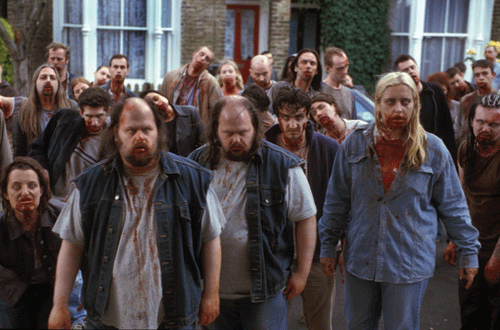

Above: "GAINS! GAAAAIIIIINNNNSSS!"

The issue is one of that characteristically vague and generally unhelpful economic concept (like most economic concepts), moral hazard. If someone doesn't face any additional risk in participating in risky behavior, so goes the idea, that person will be more likely to engage in that behavior. The standard economic example takes health insurance as an inducer of moral hazard behavior: if you're insured, you're going to be less careful when you decide to, say, allow your friend to piledrive you off of a roof into your mom's coffee table. But, like most standard economic examples, it's really stupid.

A better example of relevant and realistic moral hazard behavior is, conveniently, one of an insolvent bank. If Sol Bank discovers that he owes $100 billion to his depositors and lenders, that $10 billion is owned by the bank's shareholders, and that the $110 billion in loans he has on his books is actually worth, due to an ill-timed and entirely unexpected downturn in everything in the economy ever, $50 billion at current market prices, Sol Bank is effectively bankrupt. Even if Sol tries to sell off all of his assets, he would only be able to pay half of his liabilities off, to say nothing of his shareholders. Likewise, if Sol tries to make up the difference by borrowing the difference, that is only a temporary solution because that only increases the money he owes. Sol Bank is a Zombie Bank--its alive, but it shouldn't be--but don't tell the Treasury Department.

Sol (Braaaainns!) Bank only has one option. He can borrow some cash and try to find a series of investments that provides a much higher rate of return. Introduce Dan's Bean and Hard Boiled Egg Restaurant. Fortunately for Sol, since Dan has a terrible credit rating and is well-known for leaving his hard-boiled eggs on the stove for hours at a time, nobody will lend to him. It's for that reason that Dan has to accept a higher interest rate and it's for that reason that Sol can make big money by lending to Dan. It's a bit of a gamble for S(B!)B, since it may not be likely that Dan will actually pay any of the money back, but then again not too big a gamble: if Sol doesn't invest risky, he's certain to go under, if he does, he only might.

And that's moral hazard behavior. An insolvent bank is much more likely to make risky decisions than one that isn't, which is why almost every country in the world has fairly unequivicol regulation stating that insolvent banks cannot be allowed to exist.

So this is the potential problem the U.S. Department of Treasury now faces. If they don't act, many a-bank will go insolvent, which puts an enormous amount of pressure on an already overburdened FDIC and rattles the confidence of everyone in just about anything. If they do act, they can either a) effectively subsidize the banking industry by buying up their assets for more than their market value (giving Sol Bank $1000 for his loan to Sarah even though it isn't very likely Sarah will pay back), or b) buy the bank and absorb all of its losses. In both cases, the government is taking an enormous hit, but in the first case, the bank management stays in place and is basically rewarded for lending to bums like Sarah and Dan in the first place.

And that is moral hazard behavior. In the second case, on the other hand, you might end up with (gasp!) bureaucrats (likely handpicked off Wall Street anyway) managing the bank without succumbing to moral hazard behavior, since the demands of depositors are now insured by the proverbial printing presses of the Federal Reserve. There is no pressure to get the bank rapidly out of insolvency, only responsibly. But then we'd have something very bad which I won't even say except that it rhymes with fashion-ballzation (kind of) and then the shareholders might lose out.


Above: the face of fashion-ballzation

And in the end, when the shareholders lose out, don't we all?

*Get it? 'Cause the banks are "in the red," right? Would "Night of the Living Fed" have been better? Not quite as relevant. Maybe "Night of Living Ted-Spread"? God, I'm so lonely.

Tuesday, February 3, 2009

Same Shit, Different Financial Meltdown

While American's like to think of themselves as unique, I wonder how unique our financial crisis actually is. At first glance, it certainly seems unique in its combined breadth and severity, but if its symptoms look so much like those that affected, say, Japan between 1989-Judgment Day, an understanding of that fact might help us pick the right medicine. Or not.

In any event, here is a run down of some of the more obvious similarities between the U.S. crisis and 5 historical examples (Japan, 1989; Spain, 1977; Norway, 1987; Finland, 1991; Sweden, 1991):

Like Japan et al., the United States has seen:

  • A steep rise in housing prices during the four years preceding the crisis. (The U.S. rise was more than twice as large as the average of the other five.)
  • A steep rise in equity prices. (Again, the U.S. rise was larger.)
  • A large increase in its current account deficit.
  • A decline in per-capita growth in gross domestic product. (In this case, the U.S. situation doesn’t appear as bad as in the five predecessors.)
  • An increase in public debt. (Here again, the U.S. situation isn’t as bad as in the historical examples – but Reinhart and Rogoff add that “if one were to incorporate the huge buildup in private U.S. debt into these measures, the comparisons would be notably less favorable.”) (Source: CHE)
Of course all six of the listed countries are different economically, not to mention demographically, culturally, politically and geopolitically. So how helpful can these comparisons be? Reinhart and Rogoff compare the current crisis to the historical "standard" of economic crises as a way of predicting the future. This is obviously pretty unscientific, but if nothing else, it's an interesting article:

On other fronts the news is similarly grim, although perhaps not out of bounds of market expectations. In the typical severe financial crisis, the real (inflation-adjusted) price of housing tends to decline 36%, with the duration of peak to trough lasting five to six years. Given that U.S. housing prices peaked at the end of 2005, this means that the bottom won't come before the end of 2010, with real housing prices falling perhaps another 8%-10% from current levels.

Equity prices tend to bottom out somewhat more quickly, taking only three and a half years from peak to trough -- dropping an average of 55% in real terms, a mark the S&P has already touched. However, given that most stock indices peaked only around mid-2007, equity prices could still take a couple more years for a sustained rebound, at least by historical benchmarks.

Turning to unemployment, where the new administration is concentrating its focus, pain seems likely to worsen for a minimum of two more years. Over past crises, the duration of the period of rising unemployment averaged nearly five years, with a mean increase in the unemployment rate of seven percentage points, which would bring the U.S. to double digits.

Interestingly, unemployment is a category where rich countries, with their high levels of wage insurance and stronger worker protections, tend to experience larger problems after financial crises than do emerging markets. Emerging market economies do have deeper output falls after their banking crises, but the parallels in other areas such as housing prices are quite strong.

Perhaps the most stunning message from crisis history is the simply staggering rise in government debt most countries experience. Central government debt tends to rise over 85% in real terms during the first three years after a banking crisis. This would mean another $8 trillion or $9 trillion in the case of the U.S.

Interestingly, the main reason why debt explodes is not the much ballyhooed cost of bailing out the financial system, painful as that may be. Instead, the real culprit is the inevitable collapse of tax revenues that comes as countries sink into deep and prolonged recession. Aggressive countercyclical fiscal policies also play a role, as we are about to witness in spades here in the U.S. with the passage of a more than $800 billion stimulus bill. (Source: WSJ/BigPicture)

But even if the U.S. crisis is standard, it does more acute deflation in the stock market, for example, indicate that we will hit a market bottom sooner or just deeper? And can we compare our crisis to that of Japan considering the policy blunders that Japan made and that we have surely learned from? Actually, forget that last point. And to throw out another miscellaneous criticism, can we expect such a sharp rise in public debt given the stimulus package if that package can be expected to at least slow the decline in tax revenue?

Ultimately, it's pretty difficult to draw any historical comparisons between historical events, particularly in discussing something so politically charged as policy prescription. As Dave and I were listening to Planet Money's profile on Keynes last night, one thing was abundantly obvious: ask four economists to explain something as fundamental as the Great Depression and get five equally convincing narratives. But on the other hand, while turning economic phenomena into typologies is both scientifically and politically problematic, what else do we have to work with?