Wednesday, October 20, 2010

Always Be Foreclosing

Maybe you've heard it called the "foreclosure mess." Or, from those who can somehow still affix the suffix with a straight face, maybe it was "foreclosure-gate." And then there are the few hand-wringing bloggers, finding both "mess" and "gate" too trivial, who warn that we are already confronting with all-to-familiar obliviousness the beginnings of a full-blown "Foreclosure Crisis." But I suspect that the majority of people are calling it nothing at all, having never heard of any of this.

So much the better, according to the editorial board of the Wall Street Journal. As they see things all this hysteria--the foreclosure moratorium, the fighting words from the politicians, the bloggers, always hysteria from the bloggers--is all over a legal glitch. A minor, albeit oft-repeated, technical error. Nothing to get all riled up and frothy about, Comrade.
Talk about a financial scandal. A consumer borrows money to buy a house, doesn't make the mortgage payments, and then loses the house in foreclosure—only to learn that the wrong guy at the bank signed the foreclosure paperwork. Can you imagine? The affidavit was supposed to be signed by the nameless, faceless employee in the back office who reviewed the file, not the other nameless, faceless employee who sits in the front.

The result is the same, but politicians understand the pain that results when the anonymous paper pusher who kicks you out of your home is not the anonymous paper pusher who is supposed to kick you out of your home. Welcome to Washington's financial crisis of the week. (WSJ)
Totez. Leave it to the libs to make such a big deal out of something as trivial as property rights and contract law.

Here's the story:

Remember the housing crisis? Remember all of those complicated financial arrangements that bankers devised to make lending absurd sums of money to Guatemalan cleaning ladies a riskless proposition? The details don't really matter--only this general point: the dizzying tangle of unnecessary complexity that now connects a single mortgage payer to a single beneficiary of that payment is sufficiently labyrinthine to make even Jareth the Goblin King, codpiece and all, feel a little inferior.


Now with so many borrowers unable or otherwise unwilling to pay their mortgage debt, their homes (the collateral on those loans) are being seized by debt servicers (located either in the bank or outsourced to Knee-Breakers Corp.) and sold off, the proceeds going, minus fees, to investors. Hence, the Gregorian knot of mortgage payments is traced backwards to its source where it is unceremoniously cut.*

But now that process has stalled and most fingers initially pointed at "robo-signers." When a servicer forecloses upon a home, it must provide to the court (in states where foreclosures are passed through the court) a number of necessary documents--most notably, the actual mortgage note (the IOU)--along with a sworn affidavit that says something like, yes, it would seem that we actually have the right to take this person's house away.

But, alas, it was discovered that employees within a number of banks (GMAC, JP Morgan Chase, and Bank of America most notably) were processing these files at a rate of about a case per minute. That's a case examined and deemed to be in order, another foreclosure approved by the bank, every sixty seconds.

Now, here's the debate:

Is the problem simply that that the robo-pens are flying a little too quick for regulatory comfort, that the underpaid schlub in the front office was signing at the dotted line instead of the underpaid schlub working in the back? Is it, to paraphrase the Wall Street Journal editorial, that the servicers aren't certifying their right to foreclose on a property in exactly the proper way? Or is it that, in a number of cases, the servicers just don't have the right to foreclose, period?

Maybe, as many are suggesting, the servicers don't have all the necessary documentation. As the New York Times reported on October 2nd, one of the countries largest title insurers has suspended insuring sales on homes foreclosed by either JP Morgan Chase or GMAC until "the objectionable issues have been resolved." An explanation:
In every sale, a title insurance company insures that the title is free –and clear —that the prospective buyer is in fact buying a properly vetted house, with its title issues all in order. Title insurance companies stopped providing their service [to servicers trying to sell foreclosed-upon properties] because—of course—they didn’t want to expose themselves to the risk that the chain of title had been broken, and that the bank had illegally foreclosed on the previous owner. (The Big Picture)
In other words, these independent private insurers are refusing to sign-off on what the minute-men robots had. And while it's impossible to know exactly what those "objectionable issues" are (the author of the blurb above seems certain, but who knows?), they're obviously serious enough to raise questions over the legality of a given foreclosure.

Recall the housing boom. The business model of most mortgage originators (initial lenders) was originate-to-sell: lend money, sell the debt to a big bank on Wall Street, repeat. This process was, it goes without saying, under-regulated and the poor standards employed by the originators are evidenced by the last three years of financial history. Further up that food chain, mortgages notes (the IOUs) were often traded 18 separate times while claims on their payments were sliced and diced and repackaged down to the cent. Given all that, it certainly seems possible that some of those notes were misplaced--or at the very least, transferred from one party to the next incompletely or improperly. To avoid this, most banks began submitting these notes to a central registry, MERS. But it turns out that the folks at MERS sucked just as bad at their jobs as everyone else in the industry. A worrying statistic:

A 2008 study by the University of Iowa showed that mortgage servicers, most often than not, were neglectful in their storage of original documents that will support foreclosure. The study showed that out of the 1,700 cases of bankruptcy due to home foreclosures, 40 percent have missing original mortgage notes and other required documents. (Real Estate Pro Articles)

Now understand that within the under-regulated complex of industries called Modern Finance, the debt servicing sector stands out as one of its least regulated cogs. With little supervision, the incentives facing servicers are largely skewed towards foreclosure. An example: when homeowners stop making their payments, all existing financial arrangements pertaining to that debt enter a kind of legal limbo. Investors owning securities backed by the mortgages are entitled to their monthly payments and property taxes and insurance must be paid on the property after the first 90 days of delinquency. The servicer must cover these costs until the property is sold. Furthermore, most servicers are paid additional fixed fees to cover default and foreclosure expenses. With so many reasons to foreclose, it would thus appear that the assembly-lines lenders like Countrywide adopted during the housing boom are being re-assembled--in reverse.

And with the attempt to constantly churn out as many foreclosures as possible, like the attempt three years ago to constantly churn out as many mortgages as possible, comes the predictable fraud. Meet the new crisis, same as the old crisis:

Last year, the Department of Housing and Urban Development (HUD) received nearly 2,500 complaints about servicers, a 379 percent increase over 2007. In the first 10 months of 2009, consumers filed about 1,000 legal complaints against 10 of the largest servicers for illegal foreclosures and other predatory practices...A federal class-action suit against Ocwen asserts that it has hiked mortgage payments without fair notice, forced borrowers to buy unnecessary insurance, and intentionally processed payments late. (Mother Jones)

Unmentioned here (and on the editorial pages of the Wall Street Journal and on CNBC) is the wide-spread assertion that, in the absence of valid documentation, many servicers working on behalf of banks or bank-managed trusts simply filled in the blanks. As in, they would just make shit up. Exhibits 1, 2, and 3.

So here's the up-shot:

There has been a systemic breakdown in the national foreclosure process. What some are still trying to call a series of technical errors in actuality represents the untethering of an entire subsection of American Finance from the rule of law and property rights. Blatant fraud aside, many foreclosures seem be taking place based not on legal contract, but on the word of the servicer and the complacency and legal ignorance of the borrower. Shoddy paperwork becomes much more than just shoddy paper work when you are discussing the institution of property rights as it pertains to a 2.6 trillion dollar industry. State attorney generals and major investors are only waking up to that fact now. That is the crisis.

On one end of the broken chain of title sits a class-action law suit waiting to happen in every former homeowner who might have reason to believe that a single detail on their mortgage note was violated, plus a growing army of angry borrowers grinding the foreclosure process to a halt.

On the other end of the chain, sit the investors. Imagine this: back in '05 or '06' or '07, an investor buys a financial product offering a certain amount of cash, sliced off from a thousand different mortgage payments from a thousand different counties around the country. With the meltdown, most of those mortgage payments stopped coming. Now, as the investor waits for foreclosure to squeeze the last dollars out from a disappointing stream of payments, that investor learns that the trust that sold him the security never legally owned the underlying mortgage notes. Hell, maybe those notes were sold simultaneously to three separate banks! So now the investor, and every one of his/her counterparts, wants the principle investment back--right now and with interest too.

So what does the trustee say? We can't be entirely sure in all cases, but the blog Rortybomb gives the following real-world example of a contract between the original underwriting of a pool of mortgages (in this case Goldman Sachs) and the company that bought the pool to slice and dice for investors (in this case Deutsche Bank):

In connection with the transfer and assignment of each Mortgage Loan, the Depositor has delivered or caused to be delivered to the Trustee for the benefit of the Certificateholders the following documents or instruments with respect to each Mortgage Loan so assigned:

(i) the original Mortgage Note (except for up to 0.01% of the Mortgage Notes for which there is a lost note affidavit and the copy of the Mortgage Note) bearing all intervening endorsements showing a complete chain of endorsement from the originator to the last endorsee...In the event, with respect to any Mortgage Loan, that such original or copy of any document submitted for recordation to the appropriate public recording office is not so delivered to the Trustee within 180 days of the applicable Original Purchase Date as specified in the Purchase Agreement, the Trustee shall notify the Depositor and the Depositor shall take or cause to be taken such remedial actions under the Purchase Agreement as may be permitted to be taken thereunder, including without limitation, if applicable, the repurchase by the Responsible Party of such Mortgage Loan. (Rortybomb; emphasis his)
Get that? If any more than one in ten-thousand of the underlying mortgages notes is missing or improperly endorsed, the second bank can force the first to buy everything back. And the originator can't go back and fill in the blanks now, assuming it would be able to do so, because it had 180 days after the purchase date to do that. So all those banks with all those toxic assets sitting on their balance sheets? They might soon find themselves having to make bit more room.

This isn't solely a theoretical possibility. Just before writing this, I found this via Ezra Klein:

The Federal Reserve Bank of New York has joined a group of investors demanding that Bank of America buy back billions of dollars worth of mortgage securities that are plagued with shoddy documentation and lending standards, according to people familiar with the matter...If Bank of America refuses to comply, these investors could end up suing, a person familiar with the matter said.(Washington Post)

And never fear an insufficient number of reasons to feel fear, Felix Salmon has identified a related clusterfuck-in-the-making. This one involves investment banks potentially withholding material information from investors to whom they were selling these mortgage backed monstrosities. Which aside from not being a very gentlemanly thing to do constitutes insider trading and could serve as a solid basis for litigation--either from the SEC or any number of pissed-off investors. Or both. Oy.

With the sins of the mid-oughts potentially coming back to wreak havoc upon the balance sheets of the big banks, a number of people are predicting another full-fledged financial crisis. And this time around, it's hard to imagine any policy maker with the stomach for TARP II. For no particular reason though, I doubt things will get that apocalyptic. Maybe I'm just having a hard time imagining the big banks not finding a way to legally or politically slither out of another existential crisis. What I don't doubt is that with major financial interests opposing the banks on the so-called "buy-side," this problem isn't going away anytime soon. A month or two or three from now, if we're calling it anything, I'm guessing that we will no longer be calling this the Foreclosure Mess (or gate or crisis), but something more along the lines of Pissed-Off Investor-Gate or the There Aren't Enough Lawyers in Hell to Deal with All These Lawsuits Crisis.

But down at the ground level, I suspect that maybe a few high profile cases will bring down a particularly flagrant servicer or two--and with it, the entire foreclosure fraud issue as a publicly recognized scandal. Unless the poor paperwork was so bad as to actually invalidate existing debt (which is not going to happen and if it did would open a whole other can of worms), I have a hard time believing that the servicing and foreclosure system will suffer much more than a few aftershocks. Without regulation, the sector will remain in the shadows. And all those deadbeat defaulters that nobody cares about, without the indignation of a defrauded mutual fund or national government to back them up, will remain deadbeat defaulters, even when they aren't. In the meantime, let's all pray to Saint Elizabeth Warren.

*It is worth mentioning that in all the chatter about fraud and abuse, few are questioning the economic logic of foreclosing at all. Rortybomb has a great post on this.

Tuesday, October 19, 2010

New Age idiots kill people, puzzle over declining business

So, a New Age guru who charges 10 grand for people to go to Sedona, sit near crystals, and sweat to the oldies (by which I mean made up, poorly documented, and twisted beyond recognition Native American oldies) is being charged with manslaughter after three people (customers? visitors? pilgrims?) died and numerous others were rushed to hospital following a sweat lodge disaster. Take a look at the response from some other Sedonians:
“It was a very unfortunate and sad situation that could have happened anywhere,” said Janelle Sparkman, president of the Sedona Metaphysical Spiritual Association, who attributes the woes that New Age practitioners are experiencing to the lack of disposable income tourists have for spiritual needs and not what happened that awful afternoon. “It was not indicative of Sedona or Sedona’s practitioners at all.”
Uh... what? Three people could have died in a sweat lodge anywhere? I mean, I guess that's technically true. I mean, I don't think that the physical location of the sweat lodge made it more dangerous. If this asshole was charging 10 grand to sit in a sweat lodge in downtown Baltimore, they could have died there, too. But how the fuck is this not indicative of Sedona? Have you seen the Wikipedia page? It has a separate heading for vortices. Seems to me that, given the amount of bullshit that comes out of that corner of Arizona on a daily basis, it's probably a lot more likely that it would happen in Sedona. And for fuck's sake, one of Sedona's most well-known practitioners killed three people. If that doesn't say anything about Sedona's practitioners... Well, it does.
“Initially, I didn’t think it was going to affect business and, a year later, I know I was wrong,” said Deidre Madsen, who runs a New Age travel company in Sedona and a Web site devoted to inner growth. “I’m shocked at the impact. My business is down 20 percent.”
You're shocked at the impact. Of three people dying. You're shocked. You know, just because you believe that those three people are going to be reincarnated as rainbow dolphin angel faerie babies doesn't mean that everyone does. When people die doing something, other people don't want to do it anymore.

“We do not want an energy that we’re sitting on a graveyard,” said Amayra Hamilton, co-founder of Angel Valley. “This is about learning and appreciating life. That means expanding our understanding of life and death.”

Guess what? If you didn't want that "energy," you shouldn't have killed three people. You could have listened to the people warning about the dangers of sweat lodges, but you didn't. You went ahead, because you are goddamn greedy fucking vultures,* irregardless of whether or not you believe in the shit you peddle. Yes, IRregardless. I'm so fucking pissed I added a syllable.


Now, to end on a lighter note, here are the first couple paragraphs from the article:

SEDONA, Ariz. — There is negative energy in the air here, which the channelers, mystics, healers, psychics and other New Age practitioners of Sedona are grappling to identify and snuff out. It has to do with the recent dearth of visitors to this spiritual mecca in search of help.

Nobody is sure exactly what is keeping people away from Sedona’s four vortexes, those swirling energy sources emanating from the earth, but the effects are clear: far fewer crystals are being purchased, spiritual tours taken and treatments — from aura cleansings to Chakra balancings — ordered.

So deliciously sardonic. Kudos to you, Marc Lacey.


* Ray refused to refund his customers' money after he canceled the retreat following the deaths.

Friday, October 15, 2010

Vote on my Vote

I'm facing a dilemma. If I were the dramatic type, I might even call it a moral crisis. But not being the dramatic type, I've decided to write a blog post about it and ask for comments.

Here's the issue:
I have a ballot. It's an absentee ballot. I got it in the mail. There are ten pages and I have completed them all. From the federal level all the way down to the city, I filled-in the requisite number of broken arrows such that my infinitesimally marginal voice will be projected as loud as it can be projected. I have researched those judges looking to represent my municipal district despite an absolute dearth of relevant googleable information. I have dug deep into the comment sections of San Francisco's alternative weeklies and unearthed dirt on local school board candidates. I have figured out what an Assessor-Recorder does. But one vote remains.

Well, technically two. California state propositions 20 and 27 are opposing measures on the same issue. The issue is redistricting. The text of Prop 20 reads as follows:
Removes elected representatives from process of establishing congressional districts and transfers that authority to recently-authorized 14-member redistricting commission comprised of Democrats, Republicans, and representatives of neither party.
Prop 27 reads (allow me to paraphrase): makes Prop 20 go away, no tag-backs.

If both props carry a majority (I wouldn't put it past the California electorate), the one with the most votes wins.

As far as my principles go, I'd really prefer to vote for 20 and against 27 (that is, for the redistricting commission). As far as I can tell, gerrymandering doesn't serve any social function other than to keep incumbents in power. Also, its a fantastically effective tool to disenfranchise any residentially-concentrated minority community (see: the Spanish-speaking half of the state). Allowing a commission (selected to fit the above mentioned criteria by three state auditors, a Democrat, a Republican, and an independent, all three of whom have already been selected, also randomly) to redraw congressional districts is obviously less democratic in a direct sense, but strikes me as a little more fair and a little more legitimate.

So why do I hesitate? This is what I wrote to my mom about the same issue late last night:
But, on the other hand, why should a consistently Democratic state be diced up by a panel divided equally along partisan lines? And do we really want to take redistricting power away from our elected representatives, however noble we happen to think the idea is, when OUR elected representatives are predominantly Democratic? Do we want to be unilaterally principled when our votes are competing with (gasp!) TEXANS?!? Have you ever seen a map of Texas, district-by-district? Most people don't know this: it's a pixel portrait of Tom Delay's face.
A number of people in the pro-27 camp make the argument that while reforming the redistricting process is a worthy goal, it really ought to be done on a federal level. Otherwise, all those states most open to transparency and electoral reform (can I fairly assume these to be disproportionately blue?) will vote themselves into an electoral disadvantage against those that hold out against reform.

But can we ever really expect a law so hostile to incumbency to pass through Congress?

So what do you guys think? Imagine you're from California and then imagine that your vote makes the slightest difference. Do you vote on your principles or your partisan pragmatism?

Tuesday, October 12, 2010

Interesting things!

I don't have a job anymore! Nor do I have LSATs! That makes me somewhat able to post on the blog again, even if only to do a link round-up.

1. This is a great article on the process of acquiring medical marijuana in America's most competent state. Basically, it's easier to find a fake doctor to prescribe weed to you for your fake problems than it is to get a real doctor to agree to do the same for real problems.

2. NYT Review of Books on the drug war in Mexico. I don't have a lot of "value-added" commentary here, other than to say that this only reinforces the argument I am constantly making about the moral costs of cocaine use by Americans, Canadians, and Europeans. Also, while this is an incredibly dark and disturbing article, there are repeated references to a criminal death cult, which means that Cobra was a much more prescient movie than I am willing to admit.

3. A new language! Well, not new, but not known academically. It's also interesting because linguists aren't really sure how Koro has survived so long, considering there is no place where it is the dominant language.

4. An interview with Steve Rattner, the dude Obama czar-ified to help work out the auto industry bailouts. I confess I didn't really understand this portion of TARP, nor did I pay a lot of attention to it, but, as with the rest of the bailouts, it seems to have gone smoothly. What is most interesting about the interview, though, is the volume of spleen-venting Rattner does over Congress. He even makes two criticisms which have been around in the liberal blogosphere at least as long as Obama's been in the White House (and with which I happen to agree): one, that the presidency is weaker than the media perceives or portrays it to be (at least in domestic affairs), and that as a result negative attention that should rightly be cast towards congress is cast towards Obama, and two, that the congressional appointment system is totally screwed, to the point where even a Nobel Prize-winning economist can be kept out of the Fed.

Sunday, October 10, 2010

Just a quick thought

I'd like to know what you all think about this. First, a little background (and if you're bored to tears by the first sentence feel free to skip down the actual question).

Scott and I often discuss the ethical implications of robots. Perhaps surprisingly given our respec-tive poli-tics (try to guess who's who!), we actually agree on a lot of it. We both think that a computer brain that is indistinguishable from a human brain without cutting into it (i.e. a computer that can pass the Turing Test as consistently as a human can) must receive the full legal protection afforded to humans, since it would be impossible to state confidently that such a computer did not possess something that is equivalent to how we define human consciousness.* From this perspective we've had several quite enjoyable conversations on the topic.

Anyway, I was absently thinking about this last night (or Friday maybe) and it occurred to me that the Three Laws from Isaac Asimov's universe, which are by law written into all code in robot brains and have actually become a sort of standard among real-world roboticists working on robot AI, can perhaps be thought of as being analogous to implanting human brains with devices that block certain thoughts - i.e. complete mental censorship. If the robot can't even imagine harming a human, its mind is irreversibly handicapped by censor.

I found that idea abhorrent. To me, there can be absolutely no situation in which any body, individual or government, can have the right to restrict thought, by which I don't mean "ideas" or anything like that, but rather the actual thoughts that live in our heads. That is, the government has no right to tell a Klansman that he can not dream about lynching a black man, nor a rapist from fantasizing about rape, nor a pedophile about sex with minors. Obviously the government has every right and obligation to tell them that they are not allowed to do those things, and perhaps even that they are not allowed to speak about it in certain contexts (such as a Klan rally). But anyone is always and forever free to think whatever they want. To give a real world connection to this, I am adamantly opposed to mandatory chemical castration for sex offenders for just this reason (as California decided it would do in 1997 - several other states have since followed suit). It's a wonderful thing that chemical castration is possible, so that the "good" pedophiles,** who are aware of their attraction to children but are also aware that it would is morally abhorrent to act on their urges, can find relief. But I can simply not agree with mandatory castration on the grounds that it artificially restricts one's freedom to one's own mind.

So that brings me to my question:

Do you fellas and lady believe the same way I do that people have an eternal and inalienable right to think whatever they want within the confines of their own head?

And, of course, if you want to comment on any of the robot stuff, go right ahead.


* Incidentally, I also think that certain animals (probably some whales and dolphins, and possibly [though it's a stretch] some of the more advanced cephalopods) deserve similar protection, but the data to back that up is far from conclusive, so I reserve my moral outrage at killing them to the "but they're so cute!" stance. Well, not the cephalopods.

** And, of course, "good" rapists, who are aware that they are aroused by the thought of non-consensual sex but know it is morally abhorrent, and "good" other sex offenders. It's just a lot harder to write the phrase "good rapist" even with scare quotes then it is to write "good pedophile," because a rapist is someone who's already raped, whereas a pedophile (by my own definition, at least, I might be wrong) could just be someone sexually attracted to children, regardless of whether they've acted on that before.

Friday, September 17, 2010

Decisions, Decisions

This morning, I sat down and read a book, which would be more impressive if it wasn't a piece of pop-academia called Predictably Irrational, but as much as I have a psycho-somatic reaction to social-psychology, this was a fun, well-structured addition to my morning.

Over the past six months of deciding "What To Do With My Life and How To Make the Right Choice," I've been obsessively "self-aware," trying to factor into my decisions not only the apparent utility and costs of each option, but also the various subconscious assumptions and social pressures that have led me to evaluate each pro as a pro and con as a con. All the time I have comforted myself with the behavoiral economic/social psycological/consumer ideological assumption that the more I struggle to make the choice, the more I will subconsciously justify it in the end, releasing endorphins, creating happy receptors, and probably moving me one step closer to the Buddha.

However, if I have learnt one thing over the last year or so since graduation, it's that the worst choice one can make is none. On days when I haven't left the house, I have spent hours being anxious about all of the things that I could/should/would otherwise be doing, while failing even to finish mundane tasks such as laundry or email-responding, for fear that they might keep me homebound. Wasn't I pleased to learn that this phenome-not is being throughly studied at MIT and, most particularly, the RSA:

"The Paradox of Choice" - Rene Salecl

If you don't have half an hour to burn, Salecl's basic premise is that when faced with an abundance of choices, we imagine the costs of each choice to be much higher, become anxious about choosing anything, and fall into a state of capitalism-induced passivity.

It seems to me the paradox goes one step further - we justify what we have chosen to self-satisfaction only if we do not recognize the other options. That is, we are comfortable having spent $300 on the X-box so long as we don't think about how many textbooks we could have bought with that money (4), or meals for starving orphans in Birundi (700). On the other hand, if someone challenges our choices by presenting such options (sorry), we will often over-justify (radicalize) or refuse to make a choice in the future, depending on...(if protons were people the Bomb would work only on sunny days ending with q).

Salecl continues: under Capitalist systems, people refuse to organize or take real action themselves, and are prone to leaders who seem unduly confident (which is usually a symptom of mild to acute psychosis).

Which brings me to Mr. Glenn Beck.

"In his interview with Newsmax, Beck reveals his worst fear: that a “Reichstag moment” — a catastrophic event may soon take place so that the powers that be in Washington can end the Republic and our cherished Constitution." (glowing book review here)

"First they went for the Tea Party Protestors, and I was silent..."

On better days, I believe that Beck actually sees the similarities between American Libertarians and the Communist Party before Hitler and Stalin. On the worst days, I fear he doesn't realize the difference.

The key irony of Soviet-style countries was that the state got stronger instead of dissolving. It could never dissolve. By teaming up with the Tea Party, the Libertarian movement (distinct from the Libertarian Party) found itself a strong, popular base. (Read Jane Mayer's account in the New Yorker - brilliant despite its air of conspiracy theory). However, this base demands social legislation (abortion and gay marriage being the most prominent) that conflicts with the very principle of an unregulated society. By supporting a vague social ideology, as opposed to an overwrought Socialist (economic) one, the Tea Partisans are following their vanguard back to a Gilded Age of poverty, horrible injustice, and classical economics.

I have to laugh (having considered the other options), and hope this all blows itself apart. If it weren't for all this Captialist-passivity, I'd be at the next Tea Party rally with the rest of the psycho-Patriots, waving my sign promoting kitchen abortions, bald eagle spearing and forced sodomy (privately funded, of course).

Wednesday, September 1, 2010

The Fed Isn't Dead

As the purse strings of the federal government seem to be, with every Republican primary, with every youtube hit of Alan Simpson urinating on himself, with each anxious revolution of the corpse of Martin Luther King Jr., securely fastened, at least for the decade being, those who bother to talk about such things are beginning to talk about the Federal Reserve again. If we can't stimulate private investment directly with any more substantial spending (even if we ought to be), surely the central bank can try inundating the country in cash, shoveling out so many freshly-printed presidents that we all re-adopt the spending patterns of our golden yesteryears, if only so that we can find the living room floor again.

But wait a minute, you might be saying if this interested you in the slightest, isn't the Federal Reserve out of gas? Haven't they done all that they can do? Having pushed down short-term interest rates on government debt about as low as it will or can go and having, in the meantime, swelled its balance sheet to an unprecedented level, isn't it's proverbial powder all soggied-up (or shot out, whatever you think is more appropriate to the context)?

I don't know, but Paul Krugman and a bunch of other people are mad. In fact, they're basically calling Ben Bernanke a pussy. So what's a central banker to do?

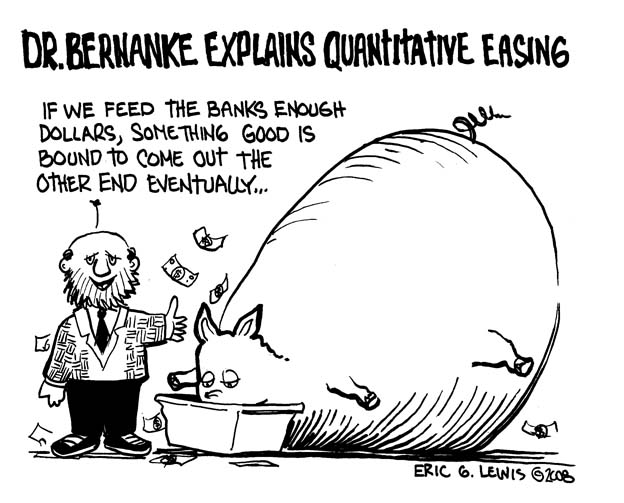
The most traditional approach would be to simply re-start what the Fed already did last year; to expand the range of assets the Fed will buy or otherwise deal with (from longer term U.S. government debt all the way out to financial toxic waste) and to re-open a lot of those fancy lending and asset buying facilities. There are an alphabet soup's worth of them, and they aren't really worth getting into because, fundamentally, they all serve the same purpose. Either through loans on rediculously easy terms or through the purchase of somewhat riskier assets, the Fed hands over to the banks (and a few other bankish things) a lot of cash. And if these banks have more cash, so the logic goes, they'll be less likely to sit on it and more likely to lend it out for, one can hope, productive, economically stimulating, purposes. Or they'll just use it all to lend back to the federal government which will in turn be prevented from spending it by Congress. But who's counting?


But, according to Nick Rowe, the particular menu of assets that the Fed decides to start devouring is not just about range, (i.e. how much more stuff it buys or how much risk it's willing to take on), but whether the particular assets in question are "pro-cyclical" (i.e. people tend to want and buy them when the economy is doing well and not so much when the economy is not so much doing well--think most stocks and, particularly this time around, houses, and, on a personal level, filet mignon) or "counter-cyclical" (think U.S. government debt, maybe gold, and McDonald's). Right now and traditionally, the Fed focuses on buying the most counter-cyclical of all counter-cyclical assets, short-term U.S. government debt. It's considered safe and it's ubiquitous as all hell--that's why the Fed deals in it. But, according to Rowe, that's exactly the wrong kind of asset to be buying now.

Suppose the Fed buys a counter-cyclical asset. If the price rises, people may interpret that rise as a sign that monetary policy is having the desired effect. Or they may interpret it as a sign the economy is getting weaker. Depending on how people interpret the rise in price of the counter-cyclical asset, and the relative strengths of the direct causal effect...the net effect on the economy is ambiguous....Suppose the Fed buys a pro-cyclical asset. If the price rises, people will interpret that as a sign that monetary policy is having the desired effect. Or they may interpret it as a sign the economy is getting stronger. Both effects work in the same, desired, direction. Also, if people thought that monetary policy was having the desired effect, and was not impotent, any increased optimism about the future path of the economy would tend to raise the price of the pro-cyclical asset still further, which would tend to make monetary policy look more effective, and reinforce that optimism. (Worthwhile Canadian Initiative)

A bit more interesting to me, and a whole lot less likely, is the suggestion of junking and then rebuilding the entire way way in which monetary policy is conducted. As I mentioned before, all the money that the central bank hopes to push into the economy through an expansive policy is funneled through the banking system. In short: federal reserve gives cash to/buy something from a national bank, and then the bank feels a little bit freer to do the same to you and me. The obvious catch, however, is that it doesn't matter how much cash a bank has, the 0% return offered by cash (or the slightly higher yield offered by a loan to the U.S. government) beats the hell out of the expected return from you and me, because you and me are both unemployed and over-indebted. I mentioned this back in January.

Also, to the extent that Rowe and others talk about the influence of higher asset prices on inflation expectation (i.e. how people respond in their spending and investment behavior to an increase in prices), the respective directions of the financial markets and of the economy at large seem prone enough to dramatic divergence (at least for longish periods of time). Which is to say, even if stocks are up, that doesn't mean we all get our jobs back.

So here's an idea from Interfluidity: rather than relying on the financial sector to serve as a conduit, why not approximate Milton Freidman's helicopter drop by simply depositing chunks of cash in the bank accounts of citizens across the country. Yeah, just like that. Give money away. For free.
That is, rather than trying to fine-tune wages, asset prices, or credit, central banks should be in the business of fine tuning a rate of transfers from the bank to the public. During depressions and disinflations, the Fed should be depositing funds directly in bank accounts at a fast clip. During booms, the rate of transfers should slow to a trickle. We could reach the “zero bound”, but a different zero bound than today’s zero interest rate bugaboo. At the point at which the Fed is making no transfers yet inflation still threatens, the central bank would have to coordinate with Congress to do “fiscal policy” in the form of negative transfers, a.k.a. taxes.(Interfluidity)
How would ensure an equal distribution of transfers? Would this create accounting issues for the Federal Reserve? What would be the optimal amount and how would we prevent people from abusing the system? The blogger, Steve Waldman, tries to address the practical questions, as if anyone would really humor the idea, or, more likely, just for the coherency the argument; it's a thought experiment for its own sake.

Which, for the time being, is what all of this is. In his last speech (which I didn't read; I'm boring, but not that boring), the Chairman Ben himself claimed that should the economy need additional help, the Fed would be willing to provide it. What that assistance would look like (and more pressingly, what an economy in need of help looks like the Fed) is, of course, just a matter of speculation.